How LPL Construction Services is Driving Tangible Environmental Action This World Environment Day

World Environment Day, observed annually on the 5th of June, serves as a critical global reminder of our collective responsibility to safeguard the natural world. For the built environment, this day carries profound significance. The construction sector has historically stood as one of the primary contributors to global greenhouse gas emissions and material waste. At LPL Construction Services, we believe that true environmental stewardship requires moving past superficial corporate pledges and into a space of rigorous measurement, open data reporting, and structural accountability.
Guided by our core corporate philosophy, Safety as Standard, we view our site operations not merely as construction projects, but as active contributions to the long-term health of our communities and ecosystems. In alignment with World Environment Day, this comprehensive review examines our newly formalised 2025 Performance Review and Recovery Pathway, which serves as Appendix A to our overarching Carbon Management Plan (SBTi verified). Appendix A was formally approved on the 19th of February 2026 by our Compliance Director, this framework works in tandem with our Sustainable Development Goals (SDG) Year 2 Reflection to demonstrate how an ethical contractor transforms sustainability into daily reality.
1. Grounding Our Footprint: The UN SDG Framework
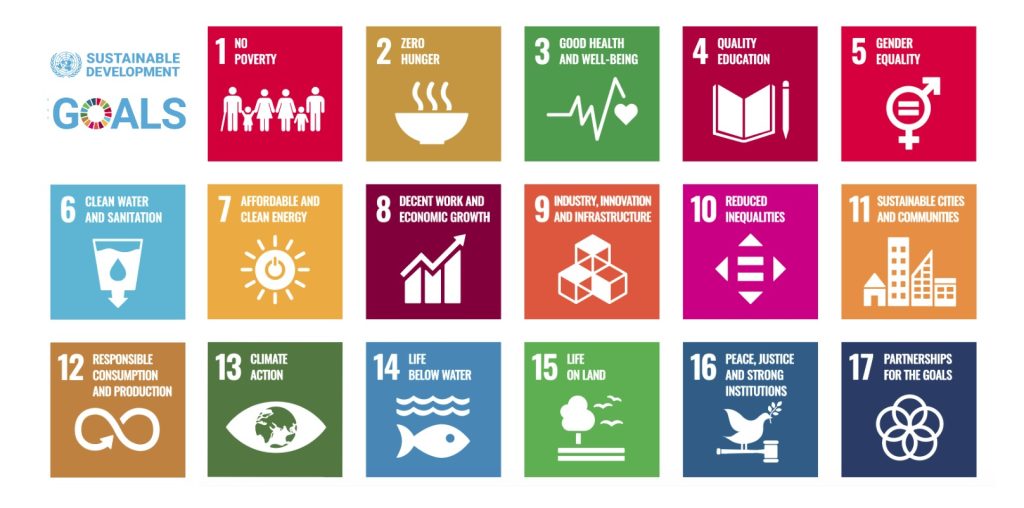
Our environmental strategy does not exist in isolation. To ensure our site operations align with international benchmarks, LPL integrates the United Nations’ 17 Sustainable Development Goals (SDGs) directly into our day-to-day delivery framework. Following the publication of our inaugural SDG report reflecting on 2023, our Year 3 report highlights a deliberate focus on the core goals most directly affected by our civil engineering, building and facility asset management:
- UN Goal 9 (Industry, Innovation & Infrastructure): We actively invest in innovative site technologies and sustainable, circular construction practices to minimise our environmental footprint and improve long-term infrastructure efficiency.
- UN Goal 11 & 12 (Sustainable Cities and Communities / Responsible Consumption & Production): By collaborating with our supply chain delivery partners and placing designing for the future at the heart of our engineering layout plans, we reduce our reliance on raw materials.
- UN Goal 13 (Climate Action): We have formalised a comprehensive Carbon Management Plan that captures our commitment as a corporate citizen to ensuring our primary operations reach net zero by 2050 or earlier.
- UN Goal 14 & 15 (Life Below Water / Life on Land): Every project we manage is strictly risk-assessed for key environmental considerations, with robust control measures and mitigating actions implemented before any site work commences to protect local flora, fauna, and water systems.
By moving beyond simple legal compliance, LPL uses these benchmarks to re-evaluate our footprint, ensuring that business success is measured by social impact and ecological care alongside traditional construction programmes and financial performance.
2. Decoupling Growth from Carbon Output: The Strategic Picture
A core component of our Carbon Management Plan is a commitment to transparent data collection and reporting. To guard against greenwashing, LPL submits its emissions data to @carbon Footprint for external and validation ahead of publishing our results. This ensures our datasets conform to the requirements of the Greenhouse Gas (GHG) Protocol are accurate and support our ISO 14001-aligned Environmental Management System.
The data from our recently finalised 2025 Performance Review demonstrates a vital trend for LPL: the partial decoupling of commercial business growth from absolute carbon output. Between the baseline year of 2022 and the close of the 2025 reporting period, LPL experienced an extraordinary phase of scaling and commercial expansion:
- Turnover Expansion: Since our baseline year (2022), LPL has seen a increase in turnover of 124% based on the 2025 reporting year period.
- Absolute Emissions Variance: Over this same period, total absolute carbon emissions across Scopes 1, 2, and 3 rose by only 23%, moving from 3,667.10 tCO2e to 4,500.79 tCO2e.
Whilst our business turnover has doubled our absolute emissions experienced only a 23% increase and when measured as an intensity ratio per million pounds of turnover, the effectiveness of our sustainable site controls becomes clear:

In straightforward terms, LPL has successfully managed to nearly halve our emissions intensity per million pounds of turnover within a three-year window. Output has grown significantly, faster than carbon emissions, indicating that our internal operational mechanisms are working to mitigate our expanding corporate footprint.
3. Scope 1 Direct Fuel Emissions: Performance Drivers and The 2026-2030 Quantified Recovery Curve
Our Scope 1 emissions, which encompass direct fuel burn from corporate fleet vehicles and specialised site plant machinery, totalled 601.26 tCO2e in 2025. This represents a marginal increase of +22.6% relative to our 2022 baseline of 490.51 tCO2e.
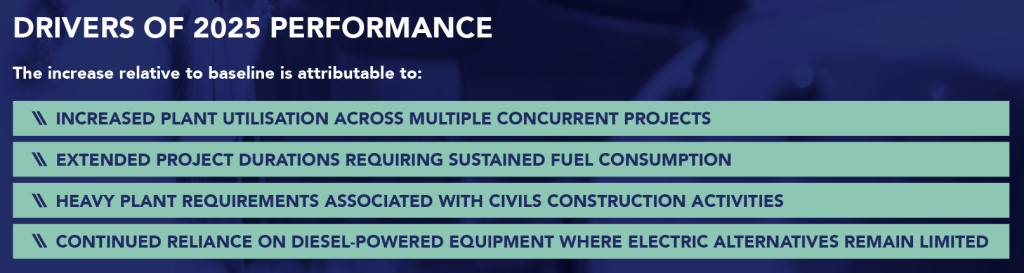
Drivers of 2025 Scope 1 Variances
This variance is primarily driven by the operational realities of our project pipeline during 2025:
- Project Concurrency and Intensity: LPL managed a higher volume of simultaneous project rollouts than in previous years, driving up total machinery run-time.
- Civils-Intensive Construction Phases: Our civil engineering and demolition divisions navigated prolonged groundworks phases requiring continuous, heavy plant utilisation.
- Alternative Plant Limitations: We encountered market constraints regarding commercially available electric alternatives for specialised heavy plant categories, necessitating a temporary continued reliance on traditional internal combustion variants.
Whilst the expanded adoption of Hydrotreated Vegetable Oil (HVO+) across suitable plant categories successfully offset a significant portion of this footprint, our compliance team has established a quantified, mandatory Scope 1 Recovery Pathway to ensure we meet our short-term target of 200 tCO2e by 2030.
The Scope 1 Annual Reduction Curve
To maintain progress, our actual output will be evaluated annually against a structured reduction trajectory. Corrective management action will be triggered immediately should our annual variance deviate by more than ±5% from these specific targets:
- 2025 Actual Baseline: 601.26 tCO2e
- 2026 Target: 480 tCO2e
- 2027 Target: 440 tCO2e
- 2028 Target: 380 tCO2e
- 2029 Target: 300 tCO2e
- 2030 Target Pathway: 200 tCO2e
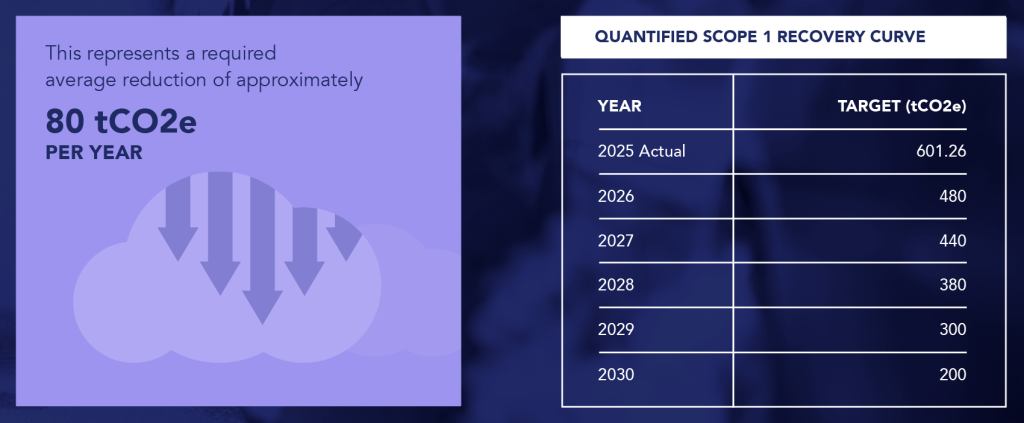
Achieving this curve requires an average reduction of approximately 80 tCO2e per year. LPL is executing four structural delivery controls across our operations to meet this objective:
I. Alternative Fuel Substitution (HVO+ Standard)
Where plant machinery can technically support alternative fuel configurations, HVO+ adoption will become our default operational standard. Fossil diesel will no longer be used as a default. To maintain senior oversight, fuel mix ratios will be audited and presented quarterly at Director level, ensuring a steady year-on-year reduction in fossil diesel dependency.
II. Advanced Plant Efficiency Controls
LPL is leveraging onboard machine telematics to monitor and actively reduce unnecessary engine idle-time when plant is not in use. Our project coordinators are additionally consolidating active plant assets across concurrent workspaces, avoiding machinery duplication and optimising scheduled running hours.
III. Fleet Renewal and Infrastructure Expansion
As part of our scheduled light commercial vehicle renewal cycles, older petrol and diesel units are being continuously phased out in favour of low-emission hybrid and full electric (EV) alternatives. To support this fleet transition, LPL is expanding our high-capacity EV charging infrastructure across our central headquarters, reducing our fossil fuel fleet proportion year on year.
IV. Structured Travel Management
We are directly targeting avoidable corporate travel through intelligent scheduling. By coordinating management and safety inspections, we minimise duplicate site visits. Where physical site presence is not operationally essential, our commercial and design teams utilise remote video-conferencing to eliminate road mileage entirely.
4. Scope 2 Purchased Electricity: On Track for Absolute Zero
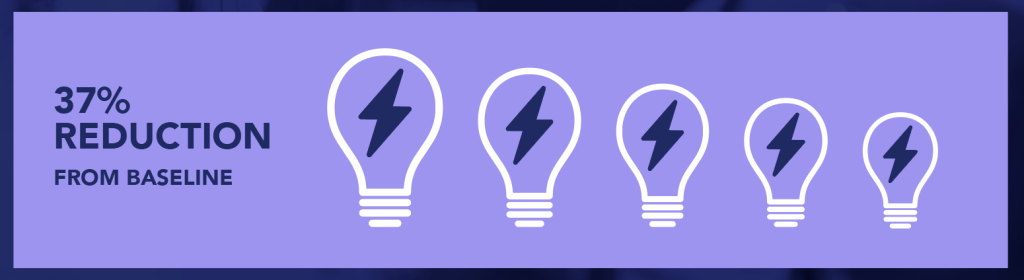
Our Scope 2 emissions, derived from purchased electricity across our fixed commercial offices and static operational facilities, dropped to 8.31 tCO2e in 2025. This marks a 37% reduction compared to our 2022 baseline of 13.18 tCO2e.
Whilst Scope 2 remains a minority contributor to LPL’s total carbon footprint, we are maintaining tight controls to prevent usage increases from tracking alongside our commercial growth. LPL has committed to migrating our entire commercial energy portfolio to a certified 100% renewable electricity provider at the earliest available contractual opportunity in 2027. This positions us ahead of our Carbon Management Plan trajectory, ensuring absolute Net Zero Scope 2 performance well in advance of our 2035 long-term backstop.
5. Scope 3 Supply Chain & Embodied Carbon: Confronting the Silent Giant
Scope 3 emissions, representing our supply chain, sub-contractor activities, and the embodied carbon of purchased building materials, comprise the largest portion of LPL’s carbon footprint. In 2025, our Scope 3 emissions totalled 3,891.22 tCO2e, a 22.6% increase from our 2022 baseline of 3,173.41 tCO2e.
Direct Drivers of the 2025 Scope 3 Profile
This absolute increase is driven by three clear engineering and methodology factors:
- Material-Intensive Project Mix: Several major infrastructure schemes progressed through heavy civils phases during 2025. These early-stage packages require substantial procurement volumes of clinker-bound concrete, reinforcement steel, granular sub-base, and significant excavation profiles. Embodied carbon rose proportionally with material throughput.
- Quarter 4 Landfill Disposals: During the final quarter of 2025, excavation-heavy operations required the disposal of approximately 13,799 tonnes of material to landfill. Landfill disposal carries a considerably higher carbon accounting penalty than diversion or recovery routes, heavily affecting our year-end profile.
- Materially Enhanced Measurement Precision: Crucially, during 2025, LPL overhauled our Scope 3 accounting methodologies to improve data completeness and transparency. We moved away from grouped, spend-based averages and integrated highly specific, localised carbon datasets, detailed waste streams, and precise material weight tracking across all projects. This improved transparency captured emissions that had been obscured in earlier reporting cycles, providing a clean, accurate baseline for forward planning.
6. The Scope 3 Recovery Curve: Material Innovation and Landfill Diversion Frameworks
Because immediate, sweeping reductions are unrealistic given our current project pipeline and accelerating business growth, LPL has developed a realistic, phased Scope 3 Recovery Pathway. Whilst our ultimate ambition remains fixed on reaching 1,000 tCO2e by 2030, our compliance model sets out a clear, step-by-step reduction curve across the interim period:
- 2025 Actual Baseline: 3891.22 tCO2e
- 2026 Target: 3,300 tCO2e
- 2027 Target: 2,900 tCO2e
- 2028 Target: 2,400 tCO2e
- 2029 Target: 1,800 tCO2e
- 2030 Target Pathway: 1,000 tCO2e
To drive our supply chain along this trajectory, LPL is deploying specific, technical procurement and site-level interventions across three critical material categories:
Concrete Decarbonisation Framework
As our largest material lever, concrete specification is being tightly managed. LPL now mandates that cement substitution ratios, such as Ground Granulated Blast-Furnace Slag (GGBS), are maximised wherever structural engineering parameters allow, significantly reducing the embodied clinker carbon per cubic metre. Our estimating teams have also integrated mandatory embodied carbon comparisons into early tender stages, ensuring lower-carbon mix formulations are locked in before contracts are awarded. We give preference to supply chain vendors able to present verified, third-party Environmental Product Declarations (EPDs).
Steel Procurement Controls
To limit primary steel energy demand, LPL mandates a strict preference for structural reinforcement steel produced via Electric Arc Furnace (EAF) routes, which carry a fraction of the carbon footprint associated with traditional coal-fired blast furnaces. Vendor haulage distances are additionally calculated and weighted during procurement to manage Scope 3 transport mileage.
Phased Waste-to-Landfill Diversion Trajectory
Recognising that a rapid shift in excavation management is not feasible on constrained civil sites, LPL has committed to a progressive, mandatory Waste Diversion Trajectory to systematically reduce landfill emissions across our project lifecycles:
- 2025 Baseline Actual: 25% Diversion Rate
- 2026 Target: 30% Diversion Rate
- 2027 Target: 35% Diversion Rate
- 2028 Target: 40% Diversion Rate
- 2029 Target: 45% Diversion Rate
- 2030 Target Pathway: 50% Diversion Rate
This steady improvement of 5% every one to two years is managed through strict internal site protocols:
- Pre-Construction Waste Forecasting: Detailed waste modelling is completed at tender stage to plan recovery routes in advance.
- Excavation Reuse Agreements: We identify regional reuse partnerships prior to breaking ground, allowing clean arisings to bypass landfill entirely.
- On-Site Crushing Schemes: Demolition arisings are crushed and processed on-site, retaining value as 6F2 or clean concrete crush for use as sub-base on our civil works or within secondary supply chains.
- Bespoke Landfill Governance Trigger: High-volume landfill disposals cannot be approved at site level and require a mandatory internal compliance review, operating as a strict last-resort mechanism.

7. Operational Actions: Circular Principles and Site Innovation
Whilst our long-term targets are governed by macro-data curves, LPL’s day-to-day operations feature practical circular construction initiatives that bring our Carbon Management Plan to life on site.
Through our long-standing infrastructure partnership with the Manchester Airport Group (MAG), LPL uses complex airport environments as a proving ground for circular material loops. At London Stansted Airport, our proactive asset management has achieved an excellent benchmark: 1 in every 12 infrastructure packages now successfully incorporates repurposed materials harvested directly from previous work areas within the same year. Rather than disposing of functional building assets, our teams carefully extract, test, and reinstall elements such as reusable internal partition systems, commercial door configurations, window assemblies, and intact carpet tiling for administrative or back-of-house areas.
Our wider materials strategies focus heavily on eliminating single-use waste streams:
- Timber Site Hoardings: Our timber hoardings achieve a 100% recycling and reuse loop, demounted and re-erected in their original configurations or repurposed as temporary shuttering components at the end of their lifecycle.
- Standardised Engineering Design: Our civil divisions utilise standardised profiles for concrete equipment bases, allowing our teams to reuse timber shuttering multiple times across different sites before material degradation occurs, maximising resource efficiency.
- Recycled Aggregate Sourcing: Through close operational integration with our sister organisation, Corr Plant Hire Ltd, LPL prioritises recycled aggregates and screened topsoils over virgin quarried products. This closed-loop procurement delivers a 15.9% reduction in our aggregate-related emissions, preventing 17.7 tonnes of CO2e from entering the atmosphere during the reporting year.
- Hybrid Welfare Units: One of our most notable operational initiatives has been the standardisation of solar-powered hybrid welfare units across our construction sites. These systems run internal lighting and low-draw charging points directly from an onboard battery bank topped up by solar panels, with the backup generator activating only when high-load appliances are in use. This delivers a 35.1% reduction in direct fossil fuel burn compared to standard diesel units, alongside meaningful noise reduction for neighbouring communities.
8. Supply Chain Governance and Open-Source Competence
True environmental responsibility cannot stop at our own gates. Given the construction sector’s heavy reliance on sub-contracting layers, our carbon reductions require the shared accountability of our entire supply chain network.
To build an accountable procurement ecosystem, LPL has integrated Alcumus SafeContractor directly into our vendor vetting workflows. This enables our commercial teams to screen suppliers prior to awarding contracts, ensuring their internal practices meet our sustainability criteria. Currently, 100% of our listed vendors hold active environmental policies, and 43% have successfully attained advanced Sustainability Gold Recognition status.
We also believe that raising industry standards requires sharing educational resources rather than restricting access to them. LPL provides our external delivery partners with free, unrestricted access to our professional interactive training portal, IHASCO. Through this initiative, subcontractors can complete fully-funded modules covering environmental awareness, waste mitigation, modern slavery avoidance, and ethical anti-bribery protocols. In our latest reporting period, our supply chain partners completed over 24 hours of environmental and compliance training modules, funded entirely by LPL. By equipping our wider team with shared knowledge, we turn ecological best practice into standard operating procedure on every site we manage.

Moving Forward with Clear Strategic Focus
World Environment Day should not be marked by hollow corporate rhetoric or short-lived marketing campaigns. For LPL Construction Services, protecting our planet is a fundamental component of our operational architecture. By reporting our metrics with complete transparency, optimising our site plant, enforcing circular material usage, and holding our supply chain to account, we continue to demonstrate that the construction industry can and must evolve.
A definitive example of this evolution is our transition from reactive mitigation toward proactive environmental improvement. Securing approximately 152 acres (61.5 hectares) of land within our local operating geography, negotiated in 2025 and finalised in early 2026, establishes a measurable baseline of land under active ecological management. This acreage will be progressively transitioned from intensive agricultural use toward habitat restoration, including the reinstatement of native hedgerows, the creation of vital habitat corridors, and, subject to airport planning consents, the development of wetland features to encourage flora and fauna recovery. Progress on hedgerow reinstatement will be tracked through measurable linear metres established, forming an annual biodiversity enhancement KPI from 2026 onward.
This structured enhancement beyond our traditional construction footprint works in tandem with our live project controls. On active sites, environmental protection remains deeply embedded through strict drainage controls, pollution prevention measures, and site-specific habitat risk assessments to ensure land-based risks are managed responsibly during operational delivery. By securing land for long-term ecological uplift and introducing measurable habitat restoration indicators, LPL fundamentally strengthens its contribution to terrestrial ecosystem resilience and expands our active alignment with UN SDG 15 (Life on Land).
Our wider corporate goals through 2026 and beyond remain equally clear: we will continue to refine our site-level environmental audit processes, advance our training benchmarks towards Gold Status within the Supply Chain Sustainability School, and upgrade our international EcoVadis standing to Gold Status. We remain firmly committed to science-based reduction principles, minimising our reliance on carbon offsets, and working towards achieving absolute Net Zero by 2050 or earlier. Together with our clients and delivery partners, LPL will continue to challenge the status quo and build with care.